Wednesday, 23 December 2009

What you want to know about Sexy Beijing's Sexy Christmas


In this Sexy Beijing video from December 2006 Su Fei tries to find out about the Christmas spirit that seems to invade China's capital every year. What do Chinese people think about Christmas? What do they know about Christian customs and what do they know about Jewish Hanukkah?

Although China is a communist country and Christmas is an official working day, Beijing is decorated with Christmas trees and full of Santa Clauses like any other capital in the world these days. Flower markets in Chaoyang district have been selling natural Christmas trees and Advent wreath with four candles. The sales person often not knowing the meaning are smart enough to know the foreigners' demand. Christmas seems like a fun holiday - as it should be - and as Chinese people do like most Western things they also "copy" Christmas - at least the decorative and fun part like getting together and exchanging gifts.

*

 HAPPY Holiday to all of you !

*

Tuesday, 17 November 2009

Boutique Hotel in Sanlitun : The Opposite House


The newly created Swire Hotels group, owned by Hong Kong-based Swire Properties, opened its first hotel "The Opposite House" in Beijing in summer 2008.


lobby of the Opposite House


exterior of the Opposite House in Sanlitun, Beijing

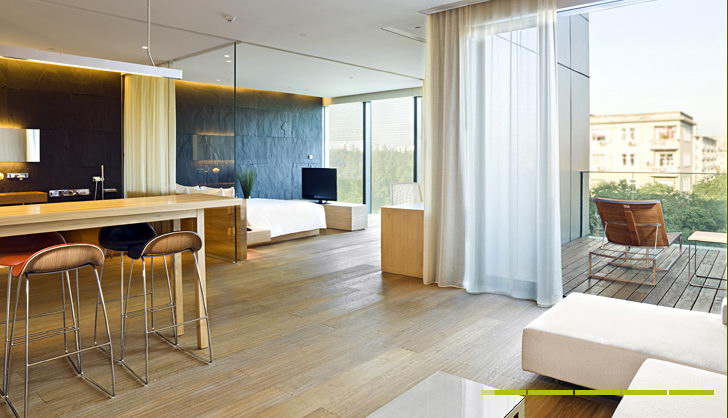
The hotel with its green glass exterior and minimalistic interior offers 99 suites starting at 1850 CNY per night (minimum stay 2 nights).


all rooms feature wooden floors and are very bright


the bathrooms feature bath tube and double sinks made of oak wood


the only traditional Chinese accessory is a wooden chest used as coffee table or storage

 
a room (studio 95) with a balcony

Designed by Japanese architect Kengo Kuma, the hotel is part of Swire's first integrated commercial project in China, a giant new shopping, lifestyle and dining development, called The Village, at Sanlitun in Beijing.  So if you wonder why all the old houses had to vanish, for what and why all these glass cubes look alike, then you know: it is all part of an integrated project by this Hong-Kong based company.


from right to left : the (South) Village, addidas store, Yashow market

If you have been in Sanlitun lately and have any dining or shopping experience in the Opposite House's neighbourhood, let me know what you think.


map and contact, click to enlarge

photo source: the opposite house

Sunday, 25 October 2009

Beijing City Guide by Design*Sponge

Maybe you already know design*sponge, a daily website dedicated to home and product design run by writer Grace Bonney. This extremely successful blog also has a growing collection of city guides, that are compiled with the help of readers. Design*Sponge city guide to Beijing is quiet a complete list of things to do & see in this fast changing city.

Like many others which are planning a trip to Beijing the authors of this city guide came across my blog. They liked the "great beijing home/decor shopping list from beijing notebook" and included a link to this blog.
Thanks for the mention !


I can recommend to check out this new online city guide as it is compiled just recently, in August 2009 and includes all the new stuff - and the old stuff that has not vanished.

Friday, 23 October 2009

This Saturday in Beijing : Urban Carpets by Instant Hutong


click on flyer (including map) to enlarge

Stefano Avesani from instant hutong send me an email to post about their event on this Saturday in Beijing. Thanks, I love to announce it here on my blog.  -   If I would still be in Beijing I would definately go. I love the atmosphere of the neighbourhood in hutongs, the small aleys in old Beijing ! And the photos of the previous exhibitions of Urban Carpets look so interesting.

Here the details :

URBAN CARPET 8x5 · 都市地毯8x5

四 4th one day-only exhibition

2009年10月25日, 11am – 6pm

NEIGHBOURHOOD COURTYARD - 社区庭院
no.17 Cao Chang Tou Tiao, Xian Yu Kou Di Qu, Chong Wen District

北京市崇文区鲜鱼口地区草厂头条17号

完美地体现了源于近几年北京郊区在不知所措地迅速变化中的矛盾。房地产政策的目的是鲜鱼口社区原住民的再次回归。对城市的传统性的描述都不适合鲜鱼口,当前是特别有趣的城乡结合。城镇的空间和自然的空间,农村的习惯和现代设备的结合,细微地体现于北京的都市中心。

Xian Yu Kou district perfectly embodies the contradictions stemming from the rapid transformations which overwhelmed Beijing neighbourhoods in the past few years. The target of real estate policies has been partially abandoned and the spaces have recently been re-occupied by the former inhabitants. None of the traditional city descriptions can suit Xian Yu Kou, which is, nowadays, a surprising and totally fascinating combination of city and countryside, urban spaces and natural ones, rural habits blended in with contemporary facilities. This micro phenomenon is taking place at the very centre of the large metropolis of Beijing.

Works by·艺术家 :

MARCELLA CAMPA & STEFANO AVESANI - http://www.instanthutong.com/


photo via instanthutong

*

I would love to hear from anyone who went their, please leave a comment.

*

Monday, 19 October 2009

Learning the meaning of Chinese Characters


I (wǒ), the hand that is holding a weapon


When learning Chinese characters you will be tought that Chinese characters are divided in six categories (六書 liùshū or "Six Writings").

To one of the six categories belong the characters that are created by two or more pictographics to a  "joined meaning" (會意 huì yì ).


example:

木 [木] mù  = 1 tree
林 [林] lín =  2 x trees = forest


Here some more "joined meanings" or so called "ideogrammic compounds" :

 亻 man leaning at a  木 tree resting  休 xiū

日 sun and 月 moon  =  bright 明 míng

 女 woman with a  子 child   =  good   好 hǎo

 力 strength working on a  田 ricefield  =   male  男 nán

豕 pig under a 宀 roof  =  family, home  家 jiā

 手 hand  holding a  戈 weapon   = I   我


Isn't this interesting how the Chinese sign for "I" (我 wǒ) was composed (above picture) ?

I am "The hand that is holding a weapon" !

This results from really rough times. If you cannot defend yourself, you cannot exist !

Actually, my latest Chinese teacher told me that the sign 我 (, engl.:  I ) is a combination of the sign for "corn" (or grain) and the sign for "weapon" (here: lance).  The corn is to feed yourself and the weapon is to defend yourself.

I could not verify if corn (禾 hé) is meant here for the first sign or if it is rather the hand  手. If there is a Chinese expert among my readers, please feel free to comment about that post!


Check out this link - it will show a new Chinese characters any minute :


I added the link to my blogroll, so anytime you visit you can learn some Chinese.
.

LinkWithin

LinkWithin Related Stories Widget for Blogs